Showing posts with label Before I Leave You. Show all posts

March 6, 2012

We've Received 39 IRNE Award Nominations!

We've received 39 IRNE Award nominations from the Independent Reviewers of New England, which recognized each our 2011 productions. The 39 nominations are five more than we received for our 2010 productions and more than twice as many as any other company in New England.


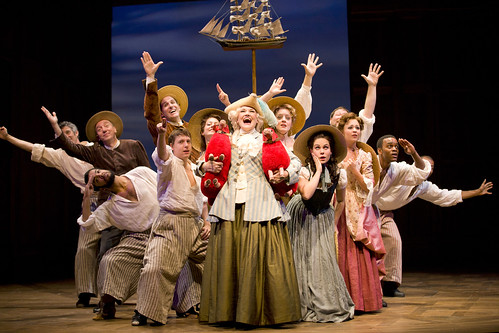
The cast of Candide, photo: T. Charles Erickson
Our September-October 2011 production of Leonard Bernstein’s glorious musical Candide received 13 nominations, more than any other production of 2011, and was nominated in every category in which it is eligible: 

October 26, 2011

What Audiences Are Saying about Before I Leave You

Audiences young and old are loving BEFORE I LEAVE YOU!


Have you seen the show yet? Share your comments with us below!

  • Whose story did you resonate with the most? The least? Why?


  • What do you think happened to each of the characters after the curtain went down?


  • Did you attend a post show conversation? What comments surprised you or made you think differently about the play? Would you attend a post show conversation again? What were you thinking about on the way home from the theatre?


  • Join the conversation!
     
The Huntington Theatre Company's production of Before I Leave You plays now through November 13, 2011 only at the Calderwood Pavilion at the BCA. Get tickets and information or call our Box Office at 617 266-0800.
     

BEFORE I LEAVE YOU: By the Numbers

Before I Leave You officially opens tonight. In case you missed The Boston Globe's fantastic cover story on October 14, here it is.


The cover of The Boston Globe's 'g' section Friday, October 14
 The Huntington Theatre Company's production of Before I Leave You plays now through November 13, 2011 only at the Calderwood Pavilion at the BCA. Get tickets and information or call our Box Office at 617 266-0800.

October 15, 2011

BEFORE I LEAVE YOU: Feedback

Ross Bickell and Kippy Goldfarb in Rosanna Yamagiwa Alfaro's BEFORE I LEAVE YOU. Now through November 13 at the Calderwood Pavilion at the BCA. huntingtontheatre.org. Photo: T. Charles Erickson

Have you seen Before I Leave You? Please share your comments with us.

Whose story did you resonate with the most? The least? Why?

What do you think happened to each of the characters after the curtain went down?

Did you attend a post show conversation? What comments surprised you or made you think differently about the play? Would you attend a post show conversation again? What were you thinking about on the way home from the theatre?


The Huntington Theatre Company's presentation of Before I Leave You plays now through November 13, 2011 only at the Calderwood Pavilion at the BCA. Get tickets and information or call our Box Office at 617 266-0800.


September 29, 2011

5 Ways To Be a Theatre Locavore

contributed by Lisa Timmel, Director of New Work

Picture a playwright. If the person you picture is dead, white, and male, I have news for you. Playwrights walk among us, living, breathing, and creating. One may be sitting next to you right now. (Generally speaking, they tend to love theatre) Unlike actors, they can be hard to spot, but if you look carefully, you can find them in warm hospitable places — mostly small, black box theatres — where these rare creatures grow. A few tips for exploring your own theatrical backyard:
    1. Bring your sense of adventure. The uncertainty of what you will find when you get to the theatre is half the fun. The next new play you see will not be exactly like one by Shakespeare, Arthur Miller, or even Lydia Diamond. The playwright may throw Aristotle out the window and start a whole new form. Surely, some plays won't suit your taste; however a play written and developed in your own community is likely to speak to truths of your own life. Occasionally, a homegrown play or company makes good in another city — the Huntington's Stick Fly and Sons of the Prophet have New York productions this fall — and it gives you one more reason to be proud of the Boston theatre scene.
    2. Go on a new play binge. Local theatre festivals and reading series are great ways to accumulate a lot of knowledge about the local theatre scene very quickly. The Boston Theater Marathon is a great place to start. The Marathon stages 50 ten-minute plays in one day. Nearly the entire theatre community participates. Just like samples at the farmer's market, the festival is a good way to learn what suits your palate. This year's Marathon will be May 19 and 20 here at the Calderwood Pavilion at the BCA.
    3. Forage through the internets. I recommend Twitter. Playwrights like Huntington Playwriting Fellow Patrick Gabridge (@patrickgabridge) tend to be "in the know" about where to go. You can also follow theatres like the Huntington (@huntington) to get the latest updates on readings and new play productions. If you, like many people, are horrified by the idea of going on Twitter, you can sign up for mailing lists. The websites for Central Square Theatre, The Factory Theatre, and Company One are good places to visit. Visit the StageSource website and sign up for StagePage, a quarterly listing of area productions that highlights work by local playwrights.
    can4. Follow the youths. Hordes of talented young people move to the Boston area to study and many of them stay and start new theatre companies. I am really curious about Fresh Ink Theatre (@FreshInkTheatre), a company whose mission is to develop new work with emerging theatre artists in the New England area. Their premiere production opens this December.
    5. Join us! Do you have a story to tell? There are lots of places to start. The "great granddaddy" of local playwright organizations is Playwrights Platform. Anyone can become a member and receive readings, feedback, and other support. The Huntington Playwriting Fellows has implemented an open application process every spring. StageSource is a local theatre networking organization that sponsors writing workshops. A new kid on the local cultivation block is Playwrights' Commons. They aim to provide retreats and other kinds of support to local writers.
Bon chance!

September 19, 2011

An Interview with playwright Rosanna Yamagiwa Alfaro

contributed by Charles Haugland:

I recently interviewed playwright Rosanna Yamagiwa Alfaro to write a note for the program of her upcoming show, BEFORE I LEAVE YOU. Parts of the interview were excerpted, so we are offering the whole, uncut interview here on the blog. Enjoy!


Rosanna Yamagiwa Alfaro
Charles Haugland: What was your first play about?  Why did you write it?
Rosanna Yamagiwa Alfaro: My first play was Behind Enemy Lines about the Japanese American internment camps.  It was an angry political play that followed the Toda family from the horse stalls in the assembly center to the tarpaper barracks in the camps and the segregation center.
CH: Tell me two big turning points in your career?
RA: Before Behind Enemy Lines (which I wrote in my late 30’s) I had published many short stories and a handful of poems.  I was enchanted when stage characters became flesh and blood.  I was utterly fascinated by the interaction of director, actors, and audience. It was a case of love at first sight, and I never wrote another short story.
The other big turning point in my career was this year when at 72 I became a Huntington Playwriting Fellow, received a MCC Artist Fellowship, and was given a slot in the 2011-2012 Huntington Theatre Season.  My son Pablo said, “It sounds like the beginning of a brilliant career.”

April 30, 2010

Expanding the Idea of New Work - Part III

Contributed by Lisa Timmel

Thanks for your thoughts, Charles. You pose some interesting questions. One question in particular really struck me: “Who are we as a theatre that sits between the two [new plays and classics]?” I think we’re always answering that question when we make programming choices. Because we can’t just program the same plays over and over, in a sense, who we are changes from play to play, from season to season. This year we were a theatre that produces American plays from the 20th and 21st centuries. The oldest play in the season was a mere 63 years old.

So if we are what we do let’s define some terms. We tend to think of plays in three main categories: Classic, contemporary and new. Since my entire career until last year was spent working off-Broadway, largely in new play development and production, I personally tend to have a very narrow definition of what constitutes a new play (I know, I know... this series of posts is about expanding the idea of new work. Bad blogger!). If a play comes with impressive quotes from a major newspaper in a major city, then it’s an established, contemporary play. When I first started out in New York, back in what my kids like to call “the nineteen hundreds”, new plays felt like they only moved in one direction: from New York to the regionals. Happily, this isn’t so much the case anymore partly because regional theatres started commissioning and producing world premieres. We now have a kind of non-profit road system for developing and promoting new work.

That said I’ve never worked for a theatre that produced an entire season of world premieres. For one thing, it often takes a production or two for the play to reach its final draft. Even ten years later, Craig Lucas rewrote parts of Prelude to a Kiss. So “new play” has to be a somewhat elastic term in that it can mean a world premiere or the latest fashion coming out of another major theatre city. Why deprive a Boston audience of a really great play just because someone else got there first? It’s also a way of participating in a national cultural conversation.

For me, contemporary plays have been knocking around a bit but are not established classics yet. Sometimes we call them revivals. I would probably have put Stick Fly and Becky Shaw in that category—definitely post-Boston if not before, and obviously Prelude to a Kiss. But how to categorize Fences, a play that is not much older than Prelude? Well, some plays are just instant classics and Wilson’s play, a play that is part of every decent American drama curriculum and revived in several cities every year qualifies. Then there are the capital C classics. Did you learn about it in school? Then it’s probably a classic. Functionally a classic play should in some way bring us back to our cultural heritage.

In the season we’re about to start, as of now it’s more of a mixed bag than last with a stronger emphasis on new plays but a wider range of tone and content. We have two world premieres, two new/contemporary plays, one contemporary play (1980), and two bonafide capital C classics. So who are we now?

- Lisa

Click to read more of this conversation

Comment on this post

April 21, 2010

Expanding the Idea of New Work, Part II

Contributed by Charles Haugland, in response to Lisa Timmel's recent post. 

I'm curious about your theory of the "Goldilocks Point," this balancing point between new work and old work that is different for every individual. I believe that it exists in the aggregate; our audience here has a balancing point for the number of new works/number of classics in our season. But, what I hear from individuals takes a different approach.

One woman tells me, "I think the Huntington should stick to the tried-and-true classics. It's what you're good at, and plays like ALL MY SONS are the ones I enjoy the most." Another says, "It's always the new plays that I think of as the Huntington's biggest successes - Melinda Lopez's SONIA FLEW or Lydia Diamond's play STICK FLY." What's remarkable to me is that neither is talking about balance. They're talking about which they prefer, and they are positioning this as a binary choice: those who like new work, those who like classics. But, is it a binary? Certainly, I don't think it is. Who are we as a theatre that sits between the two?

It gets me thinking about theatre and pleasure. And, as you say, new plays or old plays are not individually "important" for this time-based classification - whatever important means - but they do appeal to different parts of our minds and even to fundamentally different audiences.

Classic plays are a kind of active nostalgia, a longing for home. We long for old stories, we long for the turn that we know is coming, we love the terrible (or joyful) anticipation of it. How do you long for a new play?

And yet I do, and I think you do, too. We feel it as a kind of empty space in ourselves, and not for just any new play, but to hear a play that tells a story we have never heard before, a story so specific that it feels as if it's the story of our own lives, a story we've tried to tell ourselves again and again but never had the words, the images, the mirror of experience to make sense of it. (Next season has both of these kinds of pleasure for me, including this second kind of pleasure in the just-announced-today three-play Annie Baker festival.)

Is it then a relatively recent idea that the pleasure of returning to a culturally familiar story or the pleasure of an entirely new story are best experienced if they walk hand-in-hand? That is probably the subject for another post. But, from the Greeks to the Elizabethans to commercial theatres of the 19th century, there have always been both "classic" and "new" work in the marketplace, often performed by the same actors under the same roof. Did those theatres think about the Goldilocks Point? I know we do.

Depending on where you sit, regional theaters have morphed over the last fifty years into either a flippant idea of "It matters to you to see these seven plays, because we're doing them" (if anyone ever believed that idea, it is dying along with subscription numbers) or a more earnest one: These plays matter to you, because this is an ongoing conversation. These plays matter to you, because they are part of a legacy that began and is ongoing.

- Charles

What do you think? Leave your thoughts here
April 13, 2010

Expanding the Idea of New Work

For the next couple weeks, Lisa Timmel and Charles Haugland are going to have an ongoing conversation about new work at the Huntington. (They actually have that conversation everyday; they're just inviting more people in for a bit.) Stay tuned for more updates. Respond to the posts to join their conversation. Here's the first post from Lisa:

Believe it or not, next season is just around the corner. While I can’t divulge any details yet, I can say that next season features two world premieres and two highly acclaimed contemporary plays, plays that you might call “newish” including Lynn Nottage’s Pulitzer Prize winning drama, RUINED. Having taken a season off of brand-spankin’ new world premieres, jumping back in has got me thinking about the whys, the wherefores and the conventional wisdom of new play production.

Way back in January, critic Terry Teachout set the theatre blogosphere aflame when he compiled a cursory list of the most often produced plays in the States and concluded: “It suggests to me that American theaters have a pronounced bias in favor of new and newish plays by American authors, especially ones that have high public profiles.” Art Hennessy, at his Mirror up to Life blog compiled statistics for the Boston area and by his calculation new/newish plays account for well over half of all play productions here. David Mamet on the other hand has a different view: “ In 1967, when I was at acting school in New York, there were 72 new Broadway plays produced. In 2009, there were 43, of which half were revivals.” He concludes that various social and economic factors have contributed to the decline of an educated, engaged middle class audience, his requisite habitat for new plays. Although I should note that he, like the Pulitzer Prize board (according to Charles McNulty), thinks new plays only count in New York. So, it seems that contemporary plays are both thriving and dying at the same time.

Some local critics have complained that there is too much new work going on in Boston. The pleasure of experiencing a new play is very different from the pleasure of experiencing an older play and I think everyone has their goldilocks point: this theatre has too many new plays, this theatre has too few, and we’re all looking for the one that gets the balance just right. But that kind of categorical thinking unfairly limits the expansive and expanding experience of attending live theatre. A play is not important simply because it is old or because it is new. A play is important because of the specific story it tells and the unique way it is told. A play is not important simply because we choose to produce it; it is important because you come to see it.

So, why new plays? Because the world changes and perspectives shift. Because American theatre, in all its forms, thrives on the new, it always has. Our theatre history is full of the degenerate melding of forms: immigrant melodramas, minstrelsy, vaudeville and musicals all of them bubbling up into the mainstream one way or another and getting whitewashed along the way. There simply is no other way to tell the story of this country and our selves without including new work.

Incidentally, the answer to the question “Why classic plays?” is exactly the same: Because the world changes and perspectives shift. There simply is no other way to tell the story of this country and our selves without including plays from other places and other eras.

contributed by Lisa Timmel

Comment on this post