The Power of Duff marks the return of playwright Stephen Belber to the Huntington, following 2005's Carol Mulroney (the first production of ours to feature Johanna Day, who has since become a favorite of many of our audience members). Directed by our fearless leader Peter DuBois, The Power of Duff tells the story of a news anchor in Rochester named Charlie Duff who offers up a prayer on-air in honor of his recently deceased father, which in turn spins the community into a frenzy. So naturally, he keeps doing it. He soon finds himself at the center of a cult of (media) personality, while simultaneously trying to win back his estranged wife and son, neither of whom is particularly fond of Charlie's newfound spirituality. Peter worked with Stephen Belber on the show's world premiere at New York Stage & Film in the summer of 2012, and Stephen has been working hard on sharpening and honing the script for this next iteration.
At its core, The Power of Duff is the story of a desperate man's attempt to reconnect with something in the face of loss. One of the things that makes it so compelling is its multifaceted exploration of faith. The play is very much grounded in the present day, fully aware of the political climate of the country, and looks at the value and function of faith from many different perspectives. The initial prayer that sets the story off is not overtly religious by any means; Charlie himself invokes the Big G a few times, but he is hardly pious. Rather, it's a communal call to unite people together under something greater than their individual selves. Or, it's not, but that's part of what makes the story so captivating. It investigates the relationship between spirituality and religion, and the powers of community and belief.
And? It's hilarious. Seriously. The interactions between various the big-headed personalities of the newsroom where Charlie works are well worth the price of admission alone. One of my personal favorite little bits is the character of Ron Kirkpatrick, a reporter on the show who covers all kinds of bizarre and off-kilter human interest pieces on location, and only ever appears on video (it being a play about a TV news channel, there is a lot of really fascinating video projection work going on onstage as well). It's kind of like Anchorman meets The Newsroom times As Good As It Gets divided by About A Boy. Except not at all -- but admit it, you're intrigued.
Here's Peter DuBois discussing the show:

Showing posts with label new plays. Show all posts
Showing posts with label new plays. Show all posts
July 9, 2013

May 9, 2013
Gearing Up for the Boston Theatre Marathon

This weekend (May 11 and 12), Boston Playwrights’ Theatre presents the 15th annual Boston Theater Marathon and the associated Warm-Up Laps reading series. The Warm-Up Laps, now in their fourth year, present free, public readings of new plays by area playwrights, and the Marathon showcases ten hours of ten-minute plays by local writers, each produced by a different New England theatre company. Actors and directors volunteer their time, and all ticket proceeds go to the Theatre Community Benevolent Fund, a non-profit organization that provides financial relief for theatre artists and organizations who face dire need and require financial assistance.

As you might expect, a huge number of Huntington staff members,
associated artists, and other friends are involved in the fifty plays that comprise the Marathon and the three Warm-Up Labs, both of which will take place at the Calderwood Pavilion at the BCA (the Huntington donates the venue each year). The Warm-Up Laps are on Saturday at 12pm, 2pm, and 4pm in the Deane Rehearsal Hall. The following day, the Marathon itself runs from 12pm – 10pm in the Wimberly Theatre.
Five ten-minute plays run each hour, followed by a ten-minute break.
Five ten-minute plays run each hour, followed by a ten-minute break.
Amongst the Huntington affiliates whose work will be presented this weekend is 2010-2012 Huntington Playwriting Fellow Miranda Craigwell, whose Shelter will be read on Saturday at 2pm. It is directed by the Huntington’s Associate Producer, M. Bevin O'Gara. Learn more.
The Huntington’s entry in the Marathon, Saturday Matinee by Allan Appel, will perform in the 5pm hour of plays on Sunday. It is directed by yours truly, Sam Lasman (Literary Professional Intern), produced by Ali Leskowitz (Artistic Producing Professional Intern), and features Our Town actors Nicholas Carterand Jay Ben Markson.
Other plays with Huntington staff involvement include:
- Drive by James Wilkinson, produced by the Boston Children’s Theatre in the 2pm group and featuring Robert Orzalli (Calderwood Pavilion Professional Intern)
- Cleavage by Barbara Blumenthal-Ehrlich, produced by The Lyric Stage Company in the 6pm group, directed by Anna Trachtman (General Management Professional Intern) and featuring Paul Melendy from the cast of Ryan Landry’s “M”
- Rocky Road by Elisabeth Burdick, produced by Nora Theatre Company in the 8pm group, directed by Vicki Schairer (Assistant to the Artistic Director).
The work of many Huntington Playwriting Fellows will also appear in the Marathon, including:
- Joyce Van Dyke’s White Hole, produced by the Boston Center for American Performance, in the 12pm group
- John Kuntz’s The Nice Hotel, produced by Happy Medium Theatre Company, in the 1pm group
- Patrick Gabridge’s Curse the Darkness, produced by New Repertory Theatre, in the 3pm group
- Sinan Ünel’s Last Flight Out, produced by Provincetown Counter Productions, in the 4pm group
- Ronan Noone’s Boyfriend, produced by the Salem Theatre Company, in the 6pm group
- Lila Rose Kaplan’s The Chapel Play, produced by the American Repertory Theatre, in the 9pm group
Bad Habit Productions, helmed by Daniel Morris (BU Theatre House Manager) and Meg O’Brien (Manager of Education Operations) is producing Red Drink by Obehi Janice, directed by Jeff Mosser, in the 12pm group.
And, of course, the entire Marathon is organized by HPF Kate Snodgrass, who is now Artistic Director at the Boston Playwrights’ Theatre.
Learn more about the Marathon and get your tickets on BostonTheatreScene.com. We look forward to seeing you there!
May 7, 2012
Hit "The Luck of the Irish" Sets Huntington Record as it Closes
FOR
IMMEDIATE RELEASE
CONTACT:
Rebecca Curtiss, rcurtiss@huntingtontheatre.bu.edu / 617 273
1537
“THE
LUCK OF THE IRISH” CLOSES
AS HUNTINGTON THEATRE COMPANY’S HIGHEST GROSSING AND HIGHEST ATTENDED WORLD PREMIERE AT THE CALDERWOOD PAVILION AT THE BCA IN SEVEN YEARS
AS HUNTINGTON THEATRE COMPANY’S HIGHEST GROSSING AND HIGHEST ATTENDED WORLD PREMIERE AT THE CALDERWOOD PAVILION AT THE BCA IN SEVEN YEARS
(BOSTON)
– The Huntington Theatre Company’s production of Huntington Playwriting Fellow
Kirsten Greenidge’s The Luck of the Irish
closed yesterday as the highest grossing and attended Huntington world premiere
at the Calderwood Pavilion at the BCA since the fall of 2004. The Luck of the
Irish played for a total of 41 performances from March 29 through May 6,
including a one-week extension due to popular demand that was announced on April
13. Ticket demand for The Luck of the Irish was so high that an advanced
waiting list was introduced in April and final extension performances were sold
out.
The
production, which was directed by Obie Award winner Melia Bensussen, received
universal critical acclaim:
- “Superb!
Kirsten Greenidge is a writer of compassion and deep understanding...How rich
Greenidge’s dialogue is, how satisfyingly detailed the two interwoven stories
are, and how uniformly well acted The Luck of the Irish is.” – The
Boston Globe
April 19, 2012
What Audiences Are Saying About THE LUCK OF THE IRISH
Have you seen The Luck of the Irish? Please share your comments with us.
- Which characters or themes resonated most strongly with you?
- Playwright Kirsten Greenidge touches on the rarely discussed topic of ghostbuying. Do you have any experiences with ghostbuying?
- Did you attend a post-show conversation? What comments surprised you or made you think differently about the play? Would you attend a post-show conversation again? What were you thinking about on the way home from the theatre?
The Huntington Theatre Company's production of The Luck of the Irish has been extended by popular demand through May 6, 2012. It plays at the Calderwood Pavilion at the BCA. Get tickets and information or call our Box Office at 617 266-0800.
March 6, 2012
We've Received 39 IRNE Award Nominations!
We've received 39 IRNE Award nominations from the Independent Reviewers of New England, which recognized each our 2011 productions. The 39 nominations are five more than we received for our 2010 productions and more than twice as many as any other company in New England.
Our September-October 2011 production of Leonard Bernstein’s glorious musical Candide received 13 nominations, more than any other production of 2011, and was nominated in every category in which it is eligible:
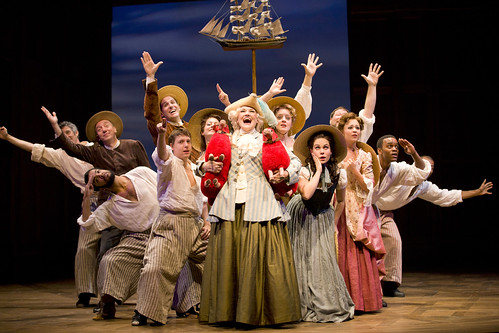 |
| The cast of Candide, photo: T. Charles Erickson |
October 26, 2011
What Audiences Are Saying about Before I Leave You
Audiences young and old are loving BEFORE I LEAVE YOU!
Have you seen the show yet? Share your comments with us below!
- Whose story did you resonate with the most? The least? Why?
- What do you think happened to each of the characters after the curtain went down?
- Did you attend a post show conversation? What comments surprised you or made you think differently about the play? Would you attend a post show conversation again? What were you thinking about on the way home from the theatre?
Join the conversation!
September 29, 2011
5 Ways To Be a Theatre Locavore
contributed by Lisa Timmel, Director of New Work
Picture a playwright. If the person you picture is dead, white, and male, I have news for you. Playwrights walk among us, living, breathing, and creating. One may be sitting next to you right now. (Generally speaking, they tend to love theatre) Unlike actors, they can be hard to spot, but if you look carefully, you can find them in warm hospitable places — mostly small, black box theatres — where these rare creatures grow. A few tips for exploring your own theatrical backyard:
- 1. Bring your sense of adventure. The uncertainty of what you will find when you get to the theatre is half the fun. The next new play you see will not be exactly like one by Shakespeare, Arthur Miller, or even Lydia Diamond. The playwright may throw Aristotle out the window and start a whole new form. Surely, some plays won't suit your taste; however a play written and developed in your own community is likely to speak to truths of your own life. Occasionally, a homegrown play or company makes good in another city — the Huntington's Stick Fly and Sons of the Prophet have New York productions this fall — and it gives you one more reason to be proud of the Boston theatre scene.
- 2. Go on a new play binge. Local theatre festivals and reading series are great ways to accumulate a lot of knowledge about the local theatre scene very quickly. The Boston Theater Marathon is a great place to start. The Marathon stages 50 ten-minute plays in one day. Nearly the entire theatre community participates. Just like samples at the farmer's market, the festival is a good way to learn what suits your palate. This year's Marathon will be May 19 and 20 here at the Calderwood Pavilion at the BCA.
- 3. Forage through the internets. I recommend Twitter. Playwrights like Huntington Playwriting Fellow Patrick Gabridge (@patrickgabridge) tend to be "in the know" about where to go. You can also follow theatres like the Huntington (@huntington) to get the latest updates on readings and new play productions. If you, like many people, are horrified by the idea of going on Twitter, you can sign up for mailing lists. The websites for Central Square Theatre, The Factory Theatre, and Company One are good places to visit. Visit the StageSource website and sign up for StagePage, a quarterly listing of area productions that highlights work by local playwrights.
- can4. Follow the youths. Hordes of talented young people move to the Boston area to study and many of them stay and start new theatre companies. I am really curious about Fresh Ink Theatre (@FreshInkTheatre), a company whose mission is to develop new work with emerging theatre artists in the New England area. Their premiere production opens this December.
- 5. Join us! Do you have a story to tell? There are lots of places to start. The "great granddaddy" of local playwright organizations is Playwrights Platform. Anyone can become a member and receive readings, feedback, and other support. The Huntington Playwriting Fellows has implemented an open application process every spring. StageSource is a local theatre networking organization that sponsors writing workshops. A new kid on the local cultivation block is Playwrights' Commons. They aim to provide retreats and other kinds of support to local writers.
Bon chance!
April 14, 2011
Now Accepting Applications for Huntington Playwriting Fellows Program
Huntington Theatre Company is now accepting applications for the 2011-2013 cohort of Huntington Playwriting Fellows (HPFs). Huntington Playwriting Fellows have a home at the Huntington with two-year residencies during which they participate in a writers’ collective with the artistic staff, attend Huntington productions and events, are eligible for readings and support through the Breaking Ground reading series, and receive a modest stipend. The HPF program is supported by the Stanford Calderwood Fund for New American Plays.
The Huntington is interested in fostering artistic relationships with local playwrights at all stages of their careers, from emerging talents to established professionals. The HPF program provides a framework for an in-depth two-year artistic conversation and a long-term professional relationship. It also encourages conversation in the Boston playwriting community. Past participants are leaders of the local community whose plays have been produced on the Huntington’s stages and throughout the country.
“I love being a Huntington Playwriting Fellow,” says Rosanna Yamagiwa Alfaro. “There’s a forty-year age span in our small group and an exciting range of styles and subject matter. Our bi-weekly discussions, under the sharp and genial direction of Lisa Timmel and Charles Haugland, are lively, helpful, and fun. I’ve never worked harder.”
 |
| Jason Dirden and Nikkole Salter in HPF Lydia R. Diamond's Stick Fly |
Many past HPFs have been produced by the Huntington including Melinda Lopez (Sonia Flew), Ronan Noone (The Atheist, Brendan), Lydia R. Diamond (Stick Fly), Rebekah Maggor (Shakespeare’s Actresses in America), and Sinan Unel (The Cry of the Reed). Ryan Landry’s Psyched will be produced as part of 2011’s Emerging America Festival. The Huntington’s 2011-2012 Season will include The Luck of the Irish, a compelling play about the “ghost-buying” of houses in segregated neighborhoods by white families on behalf of black ones, by HPF Kirsten Greenidge and Before I Leave You, a love story for grownups set in Harvard Square, by HPF Alfaro.
Application information and residency guidelines can be found online at huntingtontheatre.org/HPF. Applications will be accepted through May 18, 2011.
September 22, 2010
Breaking Ground Series continues
Contributed by Lisa Timmel
We’ve been busy and we haven’t been blogging!
Readings, readings, readings!
FIRE ON EARTH
We kicked of this year’s Breaking Ground Reading Series in late August with HPF Patrick Gabridge’s powerful historical drama FIRE ON EARTH which chronicles the struggles of William Tyndale and his friends as they illegally translate the Bible into English. Recently, Patrick wrote a couple of posts about life as a playwright in Boston on his blog, www.writinglife3.blogspot.com. Check it out.
LONG SEASON returns!
Right after Labor Day, collaborators Chay Yew and Fabian Obispo headed back to the rehearsal room in New York to rework their epic musical about the lives and loves of Filipino cannery workers in 1920’s Alaska. They ended up with a really tight structure and some fantastic new songs.
… next up
MAKING UP THE TRUTH by Jack Hitt
Directed by Jessica Bauman
Friday, September 24th at 7pm
Calderwood Pavillion at the BCA—Wimberley Theatre
Jack Hitt tells extravagant, true tales — a yarn about the childhood neighbor who was one of the first men to become a woman, or his apartment super with a deadly secret identity. But, the stories always lead people to ask, did that really happen? The Atlantic Monthly recently called This American Life contributer Jack Hitt "one of America's best storytellers." In his new show, Making Up the Truth, he shares his stories and learns that, of all things, new scientific breakthroughs point to an answer to that question: Do extraordinary things only happen to certain people, or do we all swim unaware in a sea of the uncanny and unbelievable?
Jack Hitt is a contributing writer for the New York Times Magazine, Harper's Magazine, and public radio's This American Life.
- Lisa
May 27, 2010
2010-2011 Huntington Playwriting Fellows: Apply NOW!
Contributed by Lisa Timmel
We are pleased to announce that we are accepting applications for the 2010-2011 Huntington Playwriting Fellows. The deadline is June 23, 2010.
“But wait!” you exclaim. “Didn’t you just do this last fall? It hasn’t even been a year!”
Well, dear Playwright, you're right! When the HPF program was started, the playwrights’ tenures were intended to coincide with the theatre season. Over the years, we got a bit off track and it shifted to calendar year. Charles Haugland and I realized that we needed to return to the season-to-season cycle putting the bulk of the reading into the summer months when things slow down here a bit. So the time to apply is NOW.
You can find all the information you need here: http://www.huntingtontheatre.org/new_work/playwriting-fellows.aspx
There are a few important changes to note:
· You may submit either a full-length play or a one-act
· If you have submitted a play to us since May 1, 2009 there is no need to send an additional play.
· Please send us everything via email, and most importantly,
· You may not resubmit work that was previously considered by the Huntington, this includes 2009 HPF application scripts.
We are more interested in learning about your voice or sensibility than reading polished scripts, so we encourage you to send whatever you are currently working on, even if you do not consider it completely “finished.”
We had a great time reading the applications last year and we’re really looking forward to what you all have got for us now.
Comment on this post
May 26, 2010
Expanding the Idea of New Work - Part IV

Okay, it’s up to me to wrap up the conversation. I’m going to provide a quick summary, and then leave us with a few provocations and things I will be continuing to think about.
I take you as defining three categories. (Art Hennessey also theorized three categories when he did his exhaustive tally on his blog, though he defined the categories differently)
New:
Artists are actively doing developmental work during their HTC production, particularly of text. Playwright is in residence.
Contemporary:
Plays that we have no relationship to the development. Usually they are written in the last 20ish years, but more often in the last one or two. (This definition also means that sometimes a contemporary play can be the same distance from its premiere as a new play being developed in its second production.)
Classic:
Plays that are older or canonical (i.e., We think of FENCES as classic and PRELUDE as contemporary even though they are separated by only two years.)
These categories are not represented in our theatre haphazardly. As I discussed in my last post, we think of new work and classic work as different kinds of pleasure - active nostalgia versus active synthesis - that we try to balance. A season that we think will be both embraced and challenging to our audience includes both. (Challenging goes both ways; I think there are new work devotees, you included Lisa, who can find the idea of going to see and revisit classics “challenging” to your expectations and your taste.)
What is the breakdown of our new season then?
New: VENGEANCE IS THE LORD’S and SONS OF THE PROPHET
Contemporary: CIRCLE MIRROR TRANSFORMATION and RUINED
Classic: BUS STOP, RICHARD III/COMEDY OF ERRORS, and EDUCATING RITA (Though I’m sure some would say RITA feels more contemporary than classic, it is from 1980, and has been so widely performed that I’d say it is canonical.)
A couple of wrenches that I can throw in the works:
- Many audience members told me that they had never seen ALL MY SONS. How does that effect reception? Is it “new” if it is new to you (a belief held strongly by our marketing department)?
- A good chunk of our audience had seen the Boston workshop presentation of A LONG AND WINDING ROAD or the New Haven production of A CIVIL WAR CHRISTMAS. Does it matter that they aren’t “new” to them? (In both cases, they were substantially different from their earlier productions.)
- In Peter’s first season, four out of seven plays were new and in development during their production cycle, though our audience does not remember that season as being heavily focused on new work. Why? (One thought I have is that they were all period pieces, which I believe influences reception.)
May 22, 2010
Huntington @ Boston Theatre Marathon starts TODAY!
contributed by Boston Playwright's Theatre and Lisa Timmel
BOSTON PLAYWRIGHT'S THEATRE Presents
The Boston Theater Marathon XII and the Warm-Up Laps
The Warm-Up Laps - Saturday, May 22
Presented in association with the Boston Center for the Arts at the Stanford Calderwood Pavilion at the BCA
Free and open to the public - limited to 100 seats - no reservations necessary.
Huntington Theatre Company presents
A Live Dress by Huntington Playwriting Fellow Martha Jane Kaufman
Directed by Charles Haugland - Huntington's Literary Associate.
Reading begins at 1 pm
SpeakEasy Stage Company presents
The Baptisms of St. Genesius by Richard Snee
Reading begins at 4 pm
The Publick Theatre presents
The Gift Horse by Huntington Playwriting Fellow Lydia Diamond
Reading begins at 7 pm
Boston Theater Marathon XII - Sunday, May 23
Presented in part by the Boston University Humanities Foundation.
At the Stanford Calderwood Pavilion at the Boston Center for the Arts
Ten Hours - Fifty Plays: $25 tickets in advance - $30 tickets at the door
Sunday's 10 minute plays feature:
Rosie's Things by Janet Kenney Directed by Thom Dunn, Huntington's Web and New Media Manager, in the 1PM hour
Pseudoephedrine by HPF Ken Urban/Pilgrim Theatre, in the 1PM hour
The Shit Stirring Machine by HPF Ronan Noone/Bad Habit Production, in the 4PM hour
Wasteland by HPF Kate Snodgrass Directed by Chris Carcione, Huntington's Assistant to the Artistic Director, in the 5PM hour
Confirmed Sighting by HPF Patrick Gabridge/Fort Point Theatre Channel, in the 7PM hour
Bad Santa by HPF Melinda Lopez & M. Lopez-Keough/Theatre on Fire, in the 9PM hour
Sunday's entire line up here:http://www.bu.edu/bpt/btm/lineup.html
About the Boston Theater Marathon
The BTM is a program of Boston Playwrights' Theatre and is funded by a grant from the Humanities Foundation at Boston University. We would like to thank the Huntington Theatre Company once again for donating space for this annual charity event in their new Stanford Calderwood Pavilion at the Boston Center for the Arts.
The Boston Theater Marathon is "astonishing," "exciting," "extraordinary," and, most of all, "fun." In its first seven years, the Boston Theater Marathon played to standing-room-only crowds for all 10 hours of 10-minute plays by Boston's best playwrights -- the famous, the great, the unknown, and the soon-to-be-successful. In 2004 the BTM was awarded "Boston's Best" by the Improper Bostonian for "Best Original Programming." (read more in The Buzz)
In addition to Boston’s best playwrights, you will see Boston’s best actors and directors in this celebration involving the entire Boston theatre community. All net proceeds from this charity event go a fund for actors & theatres in need called the Theatre Community Benevolent Fund. You can find out more about this fund on the StageSource website.
The plays begin at 12 noon and are performed one after the other continuously until 10 PM.
The Boston Theater Marathon is supported by a grant from The Humanities Foundation of Boston University, enabling all net proceeds to benefit The Theater Community Benevolent Fund.
In 2000, the BTM received a special Elliot Norton Award for "Enlivening Local Theatre." Read the article to learn more about this wonderful charity theatre festival.
The Judging Process - A letter from Artistic Director Kate Snodgrass
May 14, 2010
Getting Ready to Emerge
contributed by Anne Morgan
This weekend is the first annual Emerging America Festival. The festival is a unique collaboration between the Huntington, the A.R.T., and the I.C.A. The weekend will be filled with performances of all kinds all over Boston and Cambridge.
On Saturday, the Huntington will present “Two Emerging Voices/One Double Bill” at 1 and 4pm. The double bill features Love Song In Two Voices, a compelling one-woman show written and performed by Amy Herzog, and Seven Minutes in Heaven, a dynamic comedy by Steven Levenson about a middle school party.
 Also join us on Sunday for the Join The Conversation! Brunch, where you can mix and mingle with brunch food (sponsored by Panera Bread) and drinks and see exciting theatre pieces from Huntington Playwriting Fellows Ryan Landry (The Gold Dust Orphans perform selections from Showgirls), John Kuntz (with Rick Park, The Superheroine Monologues), and Martha Jane Kaufman (dance theatre piece Are Now Friends) as well as performances from Company One’s ARTiculation and the music of the Cello Chix.
For more information about these or other festival events visit emergingamericafestival.org.
The thing about this project that has been the most exciting is the number of people who’re involved. At the Huntington, this festival is being supported by all departments – production is helping us gather the props, artistic is coordinating the performers, marketing is getting the word out any way they can. But outside the Huntington, exciting talents are joining together to make this happen. For each of us working in a department at the Huntington, we are supported by our counterparts hard at work at the ART and the ICA. Our artists too are crossing boundaries. Huntington Playwriting Fellow Ryan Landry wrote an iPlay, he and his troupe The Gold Dust Orphans will delight guests at the Join the Conversation! Brunch, and he will be appearing in the ART’s presentation of Mrs. Smith Presents… A Benefit For the Carlyle Foundation Empowerment School For People and Cats with Severe and Persistent Challenges.
These past few days have been very busy. We hope you’ll check out the Emerging America Festival and enjoy everything we’ve been working on.
Comment on this post
This weekend is the first annual Emerging America Festival. The festival is a unique collaboration between the Huntington, the A.R.T., and the I.C.A. The weekend will be filled with performances of all kinds all over Boston and Cambridge.
On Saturday, the Huntington will present “Two Emerging Voices/One Double Bill” at 1 and 4pm. The double bill features Love Song In Two Voices, a compelling one-woman show written and performed by Amy Herzog, and Seven Minutes in Heaven, a dynamic comedy by Steven Levenson about a middle school party.

For more information about these or other festival events visit emergingamericafestival.org.
The thing about this project that has been the most exciting is the number of people who’re involved. At the Huntington, this festival is being supported by all departments – production is helping us gather the props, artistic is coordinating the performers, marketing is getting the word out any way they can. But outside the Huntington, exciting talents are joining together to make this happen. For each of us working in a department at the Huntington, we are supported by our counterparts hard at work at the ART and the ICA. Our artists too are crossing boundaries. Huntington Playwriting Fellow Ryan Landry wrote an iPlay, he and his troupe The Gold Dust Orphans will delight guests at the Join the Conversation! Brunch, and he will be appearing in the ART’s presentation of Mrs. Smith Presents… A Benefit For the Carlyle Foundation Empowerment School For People and Cats with Severe and Persistent Challenges.
These past few days have been very busy. We hope you’ll check out the Emerging America Festival and enjoy everything we’ve been working on.
Comment on this post
April 30, 2010
Expanding the Idea of New Work - Part III
Contributed by Lisa Timmel
 Thanks for your thoughts, Charles. You pose some interesting questions. One question in particular really struck me: “Who are we as a theatre that sits between the two [new plays and classics]?” I think we’re always answering that question when we make programming choices. Because we can’t just program the same plays over and over, in a sense, who we are changes from play to play, from season to season. This year we were a theatre that produces American plays from the 20th and 21st centuries. The oldest play in the season was a mere 63 years old.
So if we are what we do let’s define some terms. We tend to think of plays in three main categories: Classic, contemporary and new. Since my entire career until last year was spent working off-Broadway, largely in new play development and production, I personally tend to have a very narrow definition of what constitutes a new play (I know, I know... this series of posts is about expanding the idea of new work. Bad blogger!). If a play comes with impressive quotes from a major newspaper in a major city, then it’s an established, contemporary play. When I first started out in New York, back in what my kids like to call “the nineteen hundreds”, new plays felt like they only moved in one direction: from New York to the regionals. Happily, this isn’t so much the case anymore partly because regional theatres started commissioning and producing world premieres. We now have a kind of non-profit road system for developing and promoting new work.
That said I’ve never worked for a theatre that produced an entire season of world premieres. For one thing, it often takes a production or two for the play to reach its final draft. Even ten years later, Craig Lucas rewrote parts of Prelude to a Kiss. So “new play” has to be a somewhat elastic term in that it can mean a world premiere or the latest fashion coming out of another major theatre city. Why deprive a Boston audience of a really great play just because someone else got there first? It’s also a way of participating in a national cultural conversation.
For me, contemporary plays have been knocking around a bit but are not established classics yet. Sometimes we call them revivals. I would probably have put Stick Fly and Becky Shaw in that category—definitely post-Boston if not before, and obviously Prelude to a Kiss. But how to categorize Fences, a play that is not much older than Prelude? Well, some plays are just instant classics and Wilson’s play, a play that is part of every decent American drama curriculum and revived in several cities every year qualifies. Then there are the capital C classics. Did you learn about it in school? Then it’s probably a classic. Functionally a classic play should in some way bring us back to our cultural heritage.
In the season we’re about to start, as of now it’s more of a mixed bag than last with a stronger emphasis on new plays but a wider range of tone and content. We have two world premieres, two new/contemporary plays, one contemporary play (1980), and two bonafide capital C classics. So who are we now?
- Lisa
Click to read more of this conversation
Comment on this post
April 21, 2010
Expanding the Idea of New Work, Part II
Contributed by Charles Haugland, in response to Lisa Timmel's recent post.
 I'm curious about your theory of the "Goldilocks Point," this balancing point between new work and old work that is different for every individual. I believe that it exists in the aggregate; our audience here has a balancing point for the number of new works/number of classics in our season. But, what I hear from individuals takes a different approach.
One woman tells me, "I think the Huntington should stick to the tried-and-true classics. It's what you're good at, and plays like ALL MY SONS are the ones I enjoy the most." Another says, "It's always the new plays that I think of as the Huntington's biggest successes - Melinda Lopez's SONIA FLEW or Lydia Diamond's play STICK FLY." What's remarkable to me is that neither is talking about balance. They're talking about which they prefer, and they are positioning this as a binary choice: those who like new work, those who like classics. But, is it a binary? Certainly, I don't think it is. Who are we as a theatre that sits between the two?
It gets me thinking about theatre and pleasure. And, as you say, new plays or old plays are not individually "important" for this time-based classification - whatever important means - but they do appeal to different parts of our minds and even to fundamentally different audiences.
Classic plays are a kind of active nostalgia, a longing for home. We long for old stories, we long for the turn that we know is coming, we love the terrible (or joyful) anticipation of it. How do you long for a new play?
And yet I do, and I think you do, too. We feel it as a kind of empty space in ourselves, and not for just any new play, but to hear a play that tells a story we have never heard before, a story so specific that it feels as if it's the story of our own lives, a story we've tried to tell ourselves again and again but never had the words, the images, the mirror of experience to make sense of it. (Next season has both of these kinds of pleasure for me, including this second kind of pleasure in the just-announced-today three-play Annie Baker festival.)
Is it then a relatively recent idea that the pleasure of returning to a culturally familiar story or the pleasure of an entirely new story are best experienced if they walk hand-in-hand? That is probably the subject for another post. But, from the Greeks to the Elizabethans to commercial theatres of the 19th century, there have always been both "classic" and "new" work in the marketplace, often performed by the same actors under the same roof. Did those theatres think about the Goldilocks Point? I know we do.
Depending on where you sit, regional theaters have morphed over the last fifty years into either a flippant idea of "It matters to you to see these seven plays, because we're doing them" (if anyone ever believed that idea, it is dying along with subscription numbers) or a more earnest one: These plays matter to you, because this is an ongoing conversation. These plays matter to you, because they are part of a legacy that began and is ongoing.
- Charles
What do you think? Leave your thoughts here
April 13, 2010
Expanding the Idea of New Work
For the next couple weeks, Lisa Timmel and Charles Haugland are going to have an ongoing conversation about new work at the Huntington. (They actually have that conversation everyday; they're just inviting more people in for a bit.) Stay tuned for more updates. Respond to the posts to join their conversation. Here's the first post from Lisa:
Believe it or not, next season is just around the corner. While I can’t divulge any details yet, I can say that next season features two world premieres and two highly acclaimed contemporary plays, plays that you might call “newish” including Lynn Nottage’s Pulitzer Prize winning drama, RUINED. Having taken a season off of brand-spankin’ new world premieres, jumping back in has got me thinking about the whys, the wherefores and the conventional wisdom of new play production.
Way back in January, critic Terry Teachout set the theatre blogosphere aflame when he compiled a cursory list of the most often produced plays in the States and concluded: “It suggests to me that American theaters have a pronounced bias in favor of new and newish plays by American authors, especially ones that have high public profiles.” Art Hennessy, at his Mirror up to Life blog compiled statistics for the Boston area and by his calculation new/newish plays account for well over half of all play productions here. David Mamet on the other hand has a different view: “ In 1967, when I was at acting school in New York, there were 72 new Broadway plays produced. In 2009, there were 43, of which half were revivals.” He concludes that various social and economic factors have contributed to the decline of an educated, engaged middle class audience, his requisite habitat for new plays. Although I should note that he, like the Pulitzer Prize board (according to Charles McNulty), thinks new plays only count in New York. So, it seems that contemporary plays are both thriving and dying at the same time.
Some local critics have complained that there is too much new work going on in Boston. The pleasure of experiencing a new play is very different from the pleasure of experiencing an older play and I think everyone has their goldilocks point: this theatre has too many new plays, this theatre has too few, and we’re all looking for the one that gets the balance just right. But that kind of categorical thinking unfairly limits the expansive and expanding experience of attending live theatre. A play is not important simply because it is old or because it is new. A play is important because of the specific story it tells and the unique way it is told. A play is not important simply because we choose to produce it; it is important because you come to see it.
So, why new plays? Because the world changes and perspectives shift. Because American theatre, in all its forms, thrives on the new, it always has. Our theatre history is full of the degenerate melding of forms: immigrant melodramas, minstrelsy, vaudeville and musicals all of them bubbling up into the mainstream one way or another and getting whitewashed along the way. There simply is no other way to tell the story of this country and our selves without including new work.
Incidentally, the answer to the question “Why classic plays?” is exactly the same: Because the world changes and perspectives shift. There simply is no other way to tell the story of this country and our selves without including plays from other places and other eras.
contributed by Lisa Timmel
Comment on this post
August 19, 2009
Catching Up
I've been back 8 days now - and still feel rested! It was a great break and I really, really, really loved the change of pace.
Things are starting to get busy around here with the subscription campaign in full force, most of the production staff back from their summer gigs working on the shows, and rehearsals for Fences just began yesterday. Single tickets go on sale tomorrow.
I've got lots to tell you about so I'll dish it out in small servings.
I would like, first of all, to welcome Lisa Timmel to the blog. Lisa is our Director of New Work, and she joined us here at the Huntington this past spring to help us keep our new play development programs moving forward. She gave us several interesting blog posts during this summer's Breaking Ground festival and I'm looking for hearing from Lisa here on a regular basis.
Ms. Timmel recently served as the interim dramaturg and advisor to the Emerging Writers Group at the Public Theater. She has developed work by Adam Bock, Jason Grote, Sarah Ruhl, Francine Volpe, Sheila Callaghan, Steven Sater/Duncan Sheik and Tanya Barfield among others.
Previous positions include artistic producer at Carole Shorenstein Hayes Productions and director of new play development at Playwrights Horizons. Notable productions developed at Playwrights include I Am My Own Wife, Grey Gardens, Small Tragedy, and The Pain and The Itch.
Trained in dramaturgy and dramatic criticism at Columbia University (MFA), she has worked with various theater companies and developmental organizations including Sundance Theater Institute (White Oak), New Dramatists, Actors Theatre of Louisville, National Actors Theatre, INTAR, Classic Stage Company, and New Georges.
Lisa served as an adjunct professor of dramatic literature at NYU and as the staff dramaturg at The Juilliard School. Ms. Timmel holds a BA in English Literature from Kenyon College.
Welcome Lisa!
Leave your comments here
Things are starting to get busy around here with the subscription campaign in full force, most of the production staff back from their summer gigs working on the shows, and rehearsals for Fences just began yesterday. Single tickets go on sale tomorrow.
I've got lots to tell you about so I'll dish it out in small servings.
I would like, first of all, to welcome Lisa Timmel to the blog. Lisa is our Director of New Work, and she joined us here at the Huntington this past spring to help us keep our new play development programs moving forward. She gave us several interesting blog posts during this summer's Breaking Ground festival and I'm looking for hearing from Lisa here on a regular basis.
 Ms. Timmel recently served as the interim dramaturg and advisor to the Emerging Writers Group at the Public Theater. She has developed work by Adam Bock, Jason Grote, Sarah Ruhl, Francine Volpe, Sheila Callaghan, Steven Sater/Duncan Sheik and Tanya Barfield among others.
Previous positions include artistic producer at Carole Shorenstein Hayes Productions and director of new play development at Playwrights Horizons. Notable productions developed at Playwrights include I Am My Own Wife, Grey Gardens, Small Tragedy, and The Pain and The Itch.
Trained in dramaturgy and dramatic criticism at Columbia University (MFA), she has worked with various theater companies and developmental organizations including Sundance Theater Institute (White Oak), New Dramatists, Actors Theatre of Louisville, National Actors Theatre, INTAR, Classic Stage Company, and New Georges.
Lisa served as an adjunct professor of dramatic literature at NYU and as the staff dramaturg at The Juilliard School. Ms. Timmel holds a BA in English Literature from Kenyon College.
Welcome Lisa!
Leave your comments here
August 10, 2009
In Praise of the Actor’s Voice
Where does a writer’s voice come from? Beats the hell out of me. But it’s not terribly uncommon to be able to guess at what other kinds of art a playwright gets up to in the other places of his or her life. Poetry, movies, comic books, and music all leave traces on plays. That is to say, if a playwright also writes comic books, certain tropes and storytelling techniques from that literary form often show up in his plays. And vice versa. There’s nothing better for a playwright who struggles with structure than to spend a few years toiling away on a police procedural type television show. It makes perfect sense that who we are in one area of our creative, work or personal lives bleeds into who we are in other areas.Huntington Playwrighting Fellow Jacqui Parker is a well-known actor and producer in Boston. Her play Jeanie Don't Sing No Mo’ has been a long time coming. She started it in 2005 and picked it up again to work on when she became a fellow. In reading the drafts, I understood intellectually that the language, the structure of the dialogue, is intended to work in a certain rhythm. But, the story is long, the relationships are complex and I wondered how and if it would really come together as a play. Well, dear reader, you’ll be happy to know that the play came together in the reading in a way that I had not anticipated.
As the cast practically sang their way through the script, I remembered that the writing is informed by an experienced actor’s point of view. The actors, of course, understood it immediately. It is the hardest kind of writing for me to recognize, not having been an actor. Ironically, it is often the kind of writing I find most pleasurable. It was a delight really hearing Jacqui’s voice in this play for the first time.
- Lisa Timmel, Director of New Work
And Now for a Complete Change in Tone: Lydia Diamond and LIZZIE STRANTON
I have a huge girl crush on Lydia Diamond. She is smart, lovely, funny and genuine, and, as we learned during her Breaking Ground reading Tuesday night, she can tell a good dirty joke. It’s like I died and went to dramaturg heaven.Lydia’s brand spankin’ new comedy, Lizzie Stranton, is a very loose adaptation of the Greek classic, Lysistrata. Now, for those of you who don’t remember your freshman intro to drama class, the original tells the story of a group of Greek women who decide to boycott sex until their men stop the Peloponnesian War. If you haven’t read it, edumacate yourself.
Lizzie Stranton takes place in 2016, and the first lady, a woman who just so happens to resemble the ever girl-crush worthy Michelle Obama, exhorts the women of the world, a group far less repressed/oppressed than the women of ancient Greece to, well, you know.
The great joy of Lydia’s play is its earthy and genial humor. Jokes about sex (and women) are the staple of every slick and cynical stand-up comic (and the movies they make). So this particular mature-themed comedy is notable in how it combines truly filthy jokes without gratuitous exploitation. But fundamentally this play is not about sex; it’s about the long war and the seemingly unanswerable question of how to end it.
The draft we heard read on Tuesday is a fairly early one so there was much to be learned about how the text plays. Afterward, Lydia turned to me and said, “This play needs an instigating event.” Did I mention dramaturg heaven?
-Lisa Timmel, Director of New Work
August 4, 2009
Form vs. Function, Structure vs. Content and other false dichotomies
More from Director of New Work Lisa Timmel:Joyce Van Dyke’s Deported/a dream play dramatizes the Armenian Massacre of 1915 and its repercussions on a survivor by drawing on the rich tradition of expressionism in writing that came out of the traumas of the birth of psychology and the horrors of the 20th century. That is a nice little thesis, isn’t it? Is it correct or true? Maybe. Anyone can have a theory about or an opinion on a piece of writing; the crux is what to do with it. I want to write a little bit about the legacy of modernism in theatre with regard to the choices writers have to make in crafting a play.
Modernism very broadly speaking taught us to look at the structure of things as originating from content; that form should follow function. Yesterday, I posted a bit about the function of a reading in terms of new play development. By implication, the content is a bit beside the point. As with most things, it’s more complicated than that. Dramaturgs and directors have spent a lot of time coming up with creative ways of making readings more communicative to an average audience about what the end result would look like (trusting product over process?). Deported/a dream play has been through several readings and workshops recently. Director Judy Braha and the actors have been working with Joyce for about two years developing the piece, which has a stylistically expansive dramaturgy. There are songs; there are dances; there are objects and images of great symbolic importance. None of which I allowed in yesterday’s reading because I had the sense that the text was getting lost in the development process. Did I have any proof? Nope. It was a just a hunch. In any case, I needed to hear the text and I have yet to figure out how to listen to projections.
Ultimately, I believe it’s sometimes important to pay attention to the established structure and ignore the demands of the content as part of a development process. On the one hand, theatre seems like an almost endlessly pliable art form. It truly is whatever you want it to be, from guerrilla street theatre to Broadway. On the other hand, the satisfaction granted by an engaging, disciplined and familiarly drawn narrative is impossible to deny. Herein lies the rub when approaching the content of Joyce’s play. How do you write about a generation of survivors who steadfastly refused or simply did not have the ability to translate their experience into narrative? To tell the story of her ancestors who were shamed into silence about their own horrific experiences, the writer has to find a storytelling form that is neither glib and easy, nor inaccessible to the audience who does not carry this culture memory. How do you tell a story that could not be told until after it had been superseded by ever more efficient atrocities? What is the structure that can allow for the content of this story and when does the style of piece interfere with the substance?
What I love about all those modernist mad men creating new forms of theatre and writing manifestos while Europe burned around them is that they bequeathed to us an almost bottomless bag of tools for storytelling. But a creative life with out boundaries is hard to navigate. Joyce, a fiercely intelligent writer, is clearly up to the task of finding the balance, of synthesizing the competing impulses at play in her current work. I can’t wait to see where she takes us next.
Tonight: Lizzie Stranton by Lydia Diamond.
Subscribe to:
Posts (Atom)